Showing posts with label LCM. Show all posts

Thursday, August 20, 2026

A Better PeopleSoft Container "Healthcheck"


The very first PeopleSoft DPK container-native image was released two weeks ago, and we have been heads-down testing, optimizing, and strategizing our own container deployments.

Using the following command to bring up a full PeopleSoft stack is fantastic!

podman compose start

But we noticed one significant problem:

The Application Server domain would try to launch before the database TNS Listener was ready to accept connections.

This caused the Application Server domain (APPDOM) in the midtier container to fail on startup because it couldn't connect to the database. Our temporary workaround was to simply wait a minute, then manually launch psadmin.

podman exec -it --user psadm2 midtier bash -lc psadmin

But wouldn't it be nice if the full composition could wait to start the midtier until the database was ready?

What's great about Podman Compose is that it has built-in dependency checking between containers and can wait for one container to finish before loading dependent containers. To resolve our issue, therefore, we just had to change our dependency-checking algorithm, also known as the healthcheck. The default healthcheck just checks whether a file exists. This is important on the initial load (podman compose up -d) because it causes the midtier (app server and web server) to wait for the database to finish loading. But this approach falls short for subsequent launches with podman compose start. We resolved this issue by extending the healthcheck to also check the status of the listener:

    healthcheck:
      test: ["CMD-SHELL", "test -e /opt/oracle/oradata/.EP92U057.plugged && lsnrctl status | grep -qi ep92u057"]
      interval: 30s
      timeout: 5s
      retries: 30
      start_period: 5m

Have you downloaded the latest PeopleSoft Podman Container-native DPK? If so, let us know your thoughts and questions!

We are full steam ahead on a new course titled Containers for PeopleSoft that will release soon. Sign up now to get notified as soon as this course is available. Or, create a free account to stay updated on all the latest news from JSMpros!

Tuesday, August 13, 2024

Should you use the Override and/or Replace Features?

I absolutely love Isolated Customization strategies such as Event Mapping and App Engine Action Plugins. These strategies allow us to extend Oracle's delivered solution without touching Oracle-delivered code. The benefit is more efficient maintenance cycles because of fewer retrofits.

Both of these features, Event Mapping and App Engine Action Plugins, have one shortcoming: You may not use them to inject code into the middle of an Oracle-delivered code listing. Event Mapping and App Engine Action Plugins only allow code to be inserted before or after an entire listing. What if you need to inject code in the middle? Until recently, the only option was to continue modifying Oracle's delivered code.

Both Event Mapping and App Engine Action Plugins have a feature allowing a developer to replace or override Oracle's delivered code listing with your own. Customers looking for "clean" compare reports may be tempted to copy the Oracle-delivered code into their own code listing, modify it, and then replace/override Oracle's delivered code. The end result is a clean compare report and hopefully less work when applying maintenance.

But does it really work that way? Let's say you take this approach. You clone Oracle's delivered code into your own code listing. You modify your copy. You use Event Mapping or App Engine Action Plugins to replace Oracle's code. Time passes, and you apply maintenance. Since the compare reports show no customizations, you adopt Oracle's changes with no retrofits. You test the system, and because of your overrides, the system continues using your code, not Oracle's code. This is good, right? Isn't this what you want? MAYBE NOT! Oracle delivered maintenance for a reason. Did they patch a security vulnerability? Did they fix a bug? Did they alter the data model or business logic in a manner that renders your clone less effective?

If you use the override/replace in this manner, you have no way of knowing what Oracle "fixed." The only way to know that you are using the latest version of their code is to perform your own manual compare and retrofit outside of PeopleTools. And if you are going to do that, wouldn't it be easier to just modify Oracle-delivered anyway? You know what is worse? Since overridden and replaced code listings don't show on compare reports, your system may be fully patched and still suffer security vulnerabilities in your clones of Oracle-delivered code.

The Override/Replace features are fantastic for REPLACING Oracle's delivered code. In other words, if you don't want Oracle's code to run at all, then override or replace it.

Want to learn more about PeopleTools Event Mapping? Check out our one-day on-demand Event Mapping course! Or even better, subscribe and get a full year of access to the entire JSMpros on-demand PeopleTools training library!

Want to further reduce your maintenance workload? Replace customization analysis and review with PeopleSoft's Automated Testing Tool (PTF). Learn how through our two-day PTF course, which is available on-demand and live!

Wednesday, October 04, 2023

Stop Retrofitting and Analyzing Every Customization!

When applying maintenance, we must retrofit every customization. And we will have to continue analyzing and retrofitting as long as we have customizations. The process involves running Compare Reports to identify changes, analyzing customizations, and copying/pasting our old solutions into Oracle's new code base. Occasionally, we must alter a customization to account for Oracle's changes. My point is that we must touch every single customization identified in a Compare Report. The alternative is modern isolation strategies, such as  Page and Field Configurator, Event Mapping, and Drop Zones. We call these isolated customizations because changes are isolated from Oracle's delivered code base. They don't appear in Compare Reports. But should they still be analyzed? Do they require retrofits? Do they break during maintenance?

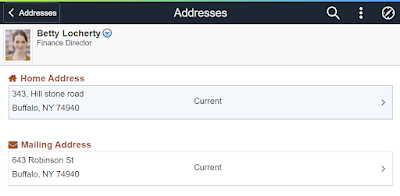
Without a Compare Report, how do you find isolated customizations? Do you need to find them? We have been discussing this lack of transparency since Event Mapping was released in PeopleTools 8.55. In fact, we've written SQL to help you locate code that includes Event Mapping that was touched by maintenance. But do we need to review every isolated customization? Here is an example. In 2016, I used Event Mapping to change the appearance of the Addresses Page. Notice the iconography next to the Home and Mailing Address in the following screenshot:


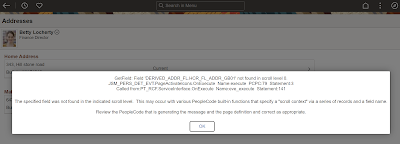
I haven't touched this isolated customization in 7 years. That is 7 years and possibly 21 "Get Currents" without a single care for this Isolated Customization! And then, I applied HCM PUM 46. Here is the result:

Event Mapping Failure


I've Waited 7 years for this to happen! Shouldn't a compare report have caught this? No. That is the point of an isolated customization. Our code is isolated from Oracle's code. Therefore, there is no Compare Report. But as you can see, sometimes our code still breaks after maintenance.

So what is the solution? How do we identify isolated customizations that broke while applying maintenance? Regression Tests. The solution to this challenge is the PTF Regression Test. Each time you create an Event Mapping, Drop Zone, or Page and Field Configurator solution, you should create a corresponding PTF regression test to prove your solution still works. A PTF Regression Test would have caught the error message and instantly failed the test. I would then analyze and retrofit just this one broken solution, not every single system change.

Compare Reports for Event Mapping, Drop Zones, and Page and Field Configurator? Do you really need them? Wouldn't a proper Regression Testing strategy save you hours, even days, of analysis by avoiding report reviews?

At JSMpros, we teach developers and business analysts how to create PTF Regression Tests through our two-day PeopleSoft Test Framework course. Find out when we are offering it next, or learn at your own pace through on-demand!